Word Counter — Why Character Count Matters
Track words, characters, sentences, and reading time. Essential for writers, students, and SEO professionals.
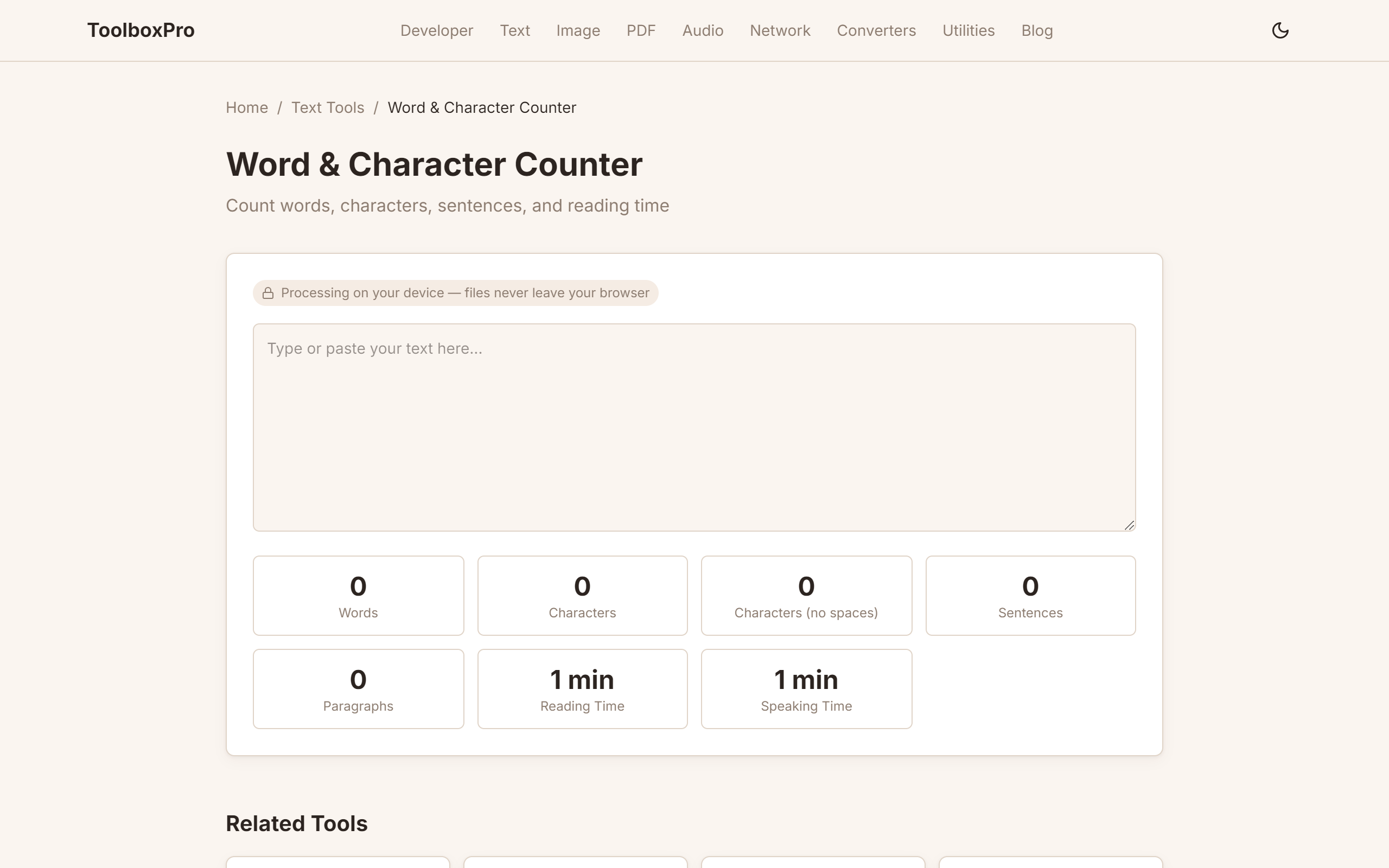
What Is a Word Counter and Why Text Metrics Matter
A word counter is a tool that analyzes text to return metrics like word count, character count, sentence count, paragraph count, and estimated reading time. While it sounds simple, accurate text metrics are essential for writers, editors, students, SEO specialists, and anyone working within content limits. Whether you're hitting a 500-word blog minimum, staying under Twitter's 280-character limit, or drafting a 2,000-word technical article, a reliable word counter keeps you on track.
Beyond raw counts, modern text analysis tools break down readability scores, keyword density, and even syllable counts. These metrics guide better writing — shorter sentences improve readability, varied word choice keeps readers engaged, and precise character limits prevent truncation on publishing platforms.
Why Accurate Word Counting Matters
Different platforms define "words" differently. A hyphenated compound like "state-of-the-art" might count as one word or three depending on the tool. Similarly, URLs, email addresses, and numbers with commas can skew counts. A good word counter applies consistent, transparent rules so you know exactly where you stand.
Content management systems (CMS) often enforce strict limits. Blog posts, meta descriptions, product titles, and alt text all have recommended or required lengths. Exceeding them means truncation in SERPs or outright rejection on submission forms. Using a reliable word counter tool before publishing saves time and prevents these issues.
Breaking Down the Key Metrics
Word Count — The total number of words in your text. This is the most common metric for essays, articles, and reports. Most academic assignments specify a word count range rather than a strict limit, and falling short or going over can affect grades.
Character Count — With or without spaces. This matters for social media posts, SMS messages, and certain form fields. Twitter's 280-character limit (most languages) and SMS's 160-character limit are classic examples where character count is king.
Sentence Count — Helps evaluate sentence variety and average sentence length. The average English sentence runs 15–20 words. Consistently longer sentences can make text harder to follow, while too many short ones can feel choppy.
Paragraph Count — Longer paragraphs (5+ sentences) work for detailed analysis, but web content benefits from 2–4 sentence paragraphs that are scannable.
| Metric | Typical Use Case | Target Range |
|---|---|---|
| Word Count | Blog posts, essays | 500–2,000 words |
| Character (no spaces) | Meta descriptions | 150–160 chars |
| Character (with spaces) | Social posts, SMS | 140–280 chars |
| Sentences | Readability analysis | 15–20 words/sentence avg |
| Reading Time | Article planning | 3–7 minutes avg |
Reading Time Estimation and Its Uses
Reading time is a derived metric based on word count and an assumed reading speed. The standard is 200–250 words per minute (WPM) for English prose. Technical content often uses 150–200 WPM, while simple copy can push 300 WPM.
Adding an estimated reading time to your articles improves user experience — readers know upfront how long the commitment is. Many publishers, blogs, and documentation sites display "X min read" badges. A reading time calculator integrated into your workflow helps you plan content length for audience retention.
Keyword Density and SEO
Keyword density measures how often a target word or phrase appears relative to total word count. While modern search engines don't treat density as a ranking signal the way they once did, monitoring it still helps you avoid over-optimization (keyword stuffing) and ensures your primary terms appear naturally.
A healthy keyword density range is 1–3%. Below 1% and you might not signal relevance; above 3% risks looking spammy. You can use a dedicated SEO text analyzer alongside your word counter for a more complete picture.
FAQ
How does a word counter define a "word"? Most word counters split text by whitespace and punctuation. Hyphenated compounds, numbers with commas, and special characters can cause discrepancies. Always check the tool's documentation for its specific rules.
What's the difference between character count with and without spaces? Character count with spaces includes every space, tab, and newline. Without spaces excludes whitespace. Social platforms typically count characters with spaces, while some form fields count without.
What reading speed should I use for estimating reading time? 200–250 WPM for general content, 150–200 WPM for technical material, and 300 WPM for simple copy. Choose based on your audience and content complexity.
Can word counters handle CJK (Chinese, Japanese, Korean) text? Some do, but CJK languages don't use spaces between words. Dedicated CJK counters use lexicon-based or ML-based tokenization rather than simple whitespace splitting.
Why does my word count differ between Microsoft Word and online tools? Word processors count differently from web-based tools. MS Word counts headers, footers, text boxes, and footnotes by default. Online tools usually count only the text you paste. Hyphenation and em-dash handling also varies.
What is a good average sentence length? 15–20 words per sentence is ideal for most readers. Technical or academic writing can go to 20–25 words, while marketing copy often targets 10–15 words for punch and clarity.
Is there a recommended meta description length? Google typically displays the first 150–160 characters of a meta description. Staying within that range ensures your full description appears in search results.
Character and Word Limits Across Platforms
Every publishing platform enforces its own limits. Knowing them prevents truncation, rejected submissions, and wasted effort:
| Platform | Limit Type | Limit | Notes |
|---|---|---|---|
| **Twitter/X** | Characters (with spaces) | 280 | Premium accounts: 25,000. CJK counts as 2 chars per symbol. |
| **SMS** | Characters | 160 (GSM-7) / 70 (UCS-2) | Emojis and non-Latin scripts switch to UCS-2 encoding, halving the limit. |
| **Instagram caption** | Characters | 2,200 | Feed truncates after ~125 chars with "more." |
| **Facebook post** | Characters | 63,206 | But engagement drops sharply after 80–100 chars. |
| **LinkedIn post** | Characters | 3,000 | Optimal engagement: 1,000–1,500 chars. |
| **Meta title (SEO)** | Characters | ~60 (512px) | Google truncates at ~512 pixels, roughly 55–60 chars. |
| **Meta description** | Characters | ~155–160 | Google displays up to ~960px on desktop (~155 chars). |
| **YouTube title** | Characters | 100 | Truncated at ~70 chars in search results. |
| **App Store title** | Characters | 30 (iOS) / 50 (Android) | Extremely tight — every character counts. |
Platform-Specific Gotchas
SEO Title and Meta Description Optimization
Character count directly impacts click-through rates from search results. Here's how to optimize:
Title Tags (55–60 Characters)
Google displays titles based on pixel width (~512px), not a strict character count. Wide characters (W, M) take more space than narrow ones (i, l). Practical guidelines:
✅ Good:  "Word Counter Tool — Free Online Character Counter | ToolboxPro" (57 chars)
❌ Bad:   "The Ultimate Comprehensive Guide to Counting Words and Characters" (66 chars — truncated)
Meta Descriptions (150–160 Characters)
✅ Good:  "Free online word counter and character count tool. Check word count,
          reading time, and keyword density instantly. No signup required." (139 chars)
❌ Bad:   "This tool helps you count words and characters in your text. It is very
          useful for writers, students, SEO professionals, and anyone who needs..." (truncated)
Academic Writing Word Count Standards
Different academic contexts have strict word count expectations. Exceeding or falling short can impact grades or acceptance:
| Document Type | Typical Word Count | Tolerance |
|---|---|---|
| **Abstract** | 150–300 words | Strict (journals enforce hard limits) |
| **Conference paper** | 6,000–8,000 words | ±10% |
| **Journal article** | 8,000–12,000 words | Varies by journal |
| **Master's thesis** | 15,000–40,000 words | Institution-specific |
| **PhD dissertation** | 70,000–100,000 words | Institution-specific |
| **College essay** | 250–650 words (US) | Common App: 250–650 |
| **Blog post (SEO)** | 1,500–2,500 words | Longer ranks better |
Tips for Academic Writers
Common Mistakes to Avoid
1. Counting characters when the platform counts words — Most CMS platforms (WordPress, Ghost) use word count for reading time estimates, but social platforms use character count. Know which metric each platform enforces.
2. Ignoring pixel-based truncation — Google truncates titles at ~512px, not 60 characters. A 58-character title with many wide letters (W, M, O) may still get cut off. Preview titles in Google's SERP simulator.
3. Stuffing keywords to hit a word count — Adding filler to reach 2,000 words hurts readability and SEO. Google's helpful content guidelines penalize thin, padded content. Write naturally first, then check the count.
Real-World Examples
Optimizing a Blog Post for SEO
A content writer drafts a 1,800-word article on "remote work productivity." They check the meta title (58 chars — within limit), meta description (152 chars — perfect), and keyword density for "remote work" (2.1% — within the 1–3% healthy range). The reading time displays as "7 min read," setting reader expectations accurately.
Hitting a College Essay Limit
A student writes a Common Application essay. The platform enforces a 650-word limit. Using a word counter, they trim from 720 to 648 words by removing redundant adjectives and tightening transitions — without losing the essay's core message.
Comparison: Word Counting Tools
| Tool | Platform | Real-Time | Extra Metrics | Free |
|---|---|---|---|---|
| **ToolboxPro Word Counter** | Web (browser) | Yes | Reading time, keyword density, sentences | Yes |
| **Microsoft Word** | Desktop | Yes | Detailed (incl. footnotes, headers) | Paid |
| **Google Docs** | Web | Yes | Basic (word, character count) | Free |
| **Grammarly** | Web/Extension | Yes | Readability score, suggestions | Freemium |
| **Hemingway Editor** | Web/Desktop | Yes | Grade level, passive voice | Free/Paid |
Recommendation: Use a browser-based word counter for quick checks across devices. Use Microsoft Word or Google Docs for integrated writing workflows. Use Grammarly or Hemingway when you need readability analysis alongside raw counts.
Try it yourself with our free online tool:
Try Word Counter →