How to Generate UUIDs Online — Complete Guide to UUID v4
Learn everything about UUIDs: what they are, UUID v4 vs v7, how to generate them instantly online, and best practices for using UUIDs as primary keys and identifiers.
What is a UUID?
A UUID (Universally Unique Identifier) is a 128-bit identifier standardized by the Open Software Foundation (OSF). It's designed to be unique across space and time — no central authority needed.
UUIDs look like this:
\\\`
550e8400-e29b-41d4-a716-446655440000
\\\`
That's 32 hexadecimal characters arranged in 5 groups: 8-4-4-4-12.
Why Use UUIDs?
1. Distributed Systems
Auto-increment IDs break when you have multiple databases generating IDs simultaneously. Two servers could both generate ID 42. UUIDs eliminate collisions entirely.
2. Security Through Obscurity
Sequential IDs (1, 2, 3...) let anyone guess how many users or orders you have. UUIDs are unpredictable — no one can guess a valid ID.
3. Offline Generation
UUIDs can be generated without a database or central server. Your mobile app can create UUIDs offline and sync later with zero conflicts.
4. Database Migration Friendly
Merging two databases with auto-increment IDs is a nightmare of re-mapping foreign keys. UUIDs never conflict, so merging is trivial.
UUID Versions Explained
UUID v4 (Random)
The most common version. All bits except 6 are randomly generated:
\\\`
xxxxxxxx-xxxx-4xxx-yxxx-xxxxxxxxxxxx
\\\`
Collision probability: You'd need to generate 2.71 trillion UUIDs to have a 50% chance of a single collision. In practice: zero.
UUID v7 (Time-Ordered)
Newer version (RFC 9562) that's time-sortable. The first 48 bits are a Unix timestamp in milliseconds:
\\\`
018f3a6e-1b3c-7d45-a123-456789abcdef
\\\`
Why v7 matters: Database indexes on UUIDs were slow because random ordering caused page splits. Time-ordered UUIDs solve this — new rows go to the end of the index, just like auto-increment.
How to Generate UUIDs
Using ToolboxPro
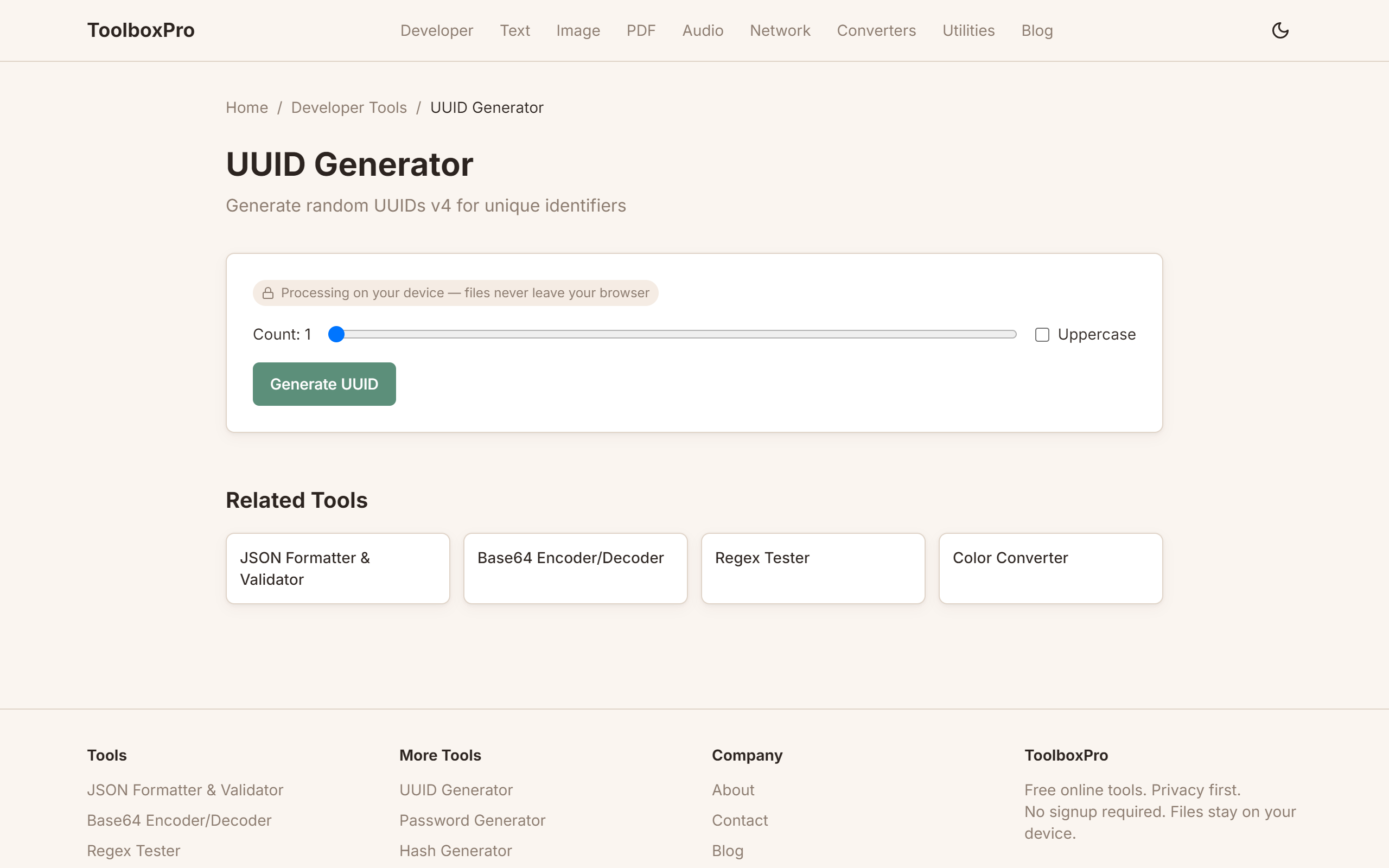
Visit our UUID Generator and:
1. Choose the UUID version (v4 or v7)
2. Select how many to generate (1 to 1000)
3. Click Generate
4. Choose your output format — lowercase, uppercase, or without hyphens
5. Copy with one click
The Bulk Generation Feature
Need 500 UUIDs for seeding a database? Set the count to 500, click Generate, and copy them all at once. Each UUID is cryptographically random — no patterns, no collisions.
UUID Best Practices
As Database Primary Keys
\\\`sql
-- PostgreSQL has a native UUID type
CREATE TABLE users (
id UUID DEFAULT gen_random_uuid() PRIMARY KEY,
name TEXT NOT NULL
);
-- MySQL use CHAR(36) or BINARY(16)
CREATE TABLE users (
id BINARY(16) PRIMARY KEY,
name VARCHAR(255) NOT NULL
);
\\\`
Storage Optimization
When NOT to Use UUIDs
FAQ
Can two UUIDs be the same? Theoretically yes, but practically no. The odds are so astronomically low that you'd win the lottery 50 times in a row first.
What's the difference between UUID and GUID? Nothing — GUID is Microsoft's implementation of the UUID standard. They're interchangeable.
Are UUIDs cryptographically secure? UUID v4 uses random bytes. On most systems these are cryptographically strong (JavaScript's crypto.randomUUID() uses the OS CSPRNG).
How many UUIDs can I generate per second? Unlimited — our tool generates them client-side in milliseconds. Try generating 10,000 and see for yourself.
UUID Collision Probability: The Real Numbers
The math behind UUID uniqueness is worth understanding because it directly affects your architecture decisions.
For UUID v4 with 122 random bits, the birthday paradox tells us when a collision becomes likely:
| UUIDs Generated | Collision Probability | Real-World Equivalent |
|---|---|---|
| 2.71 × 10³ (2,710) | 1 in 10¹⁸ | Winning the lottery twice |
| 103 trillion | 1 in a billion | Being struck by lightning |
| 2.71 × 10¹⁸ | 50% chance | Heat death of the universe first |
To hit a 50% collision chance, you'd need to generate 1 billion UUIDs per second for 85 years. For any practical application, collisions do not happen.
When Collisions CAN Happen
UUID v4 vs v7: Which to Choose
| Aspect | UUID v4 | UUID v7 |
|---|---|---|
| Ordering | Random | Time-sorted (ms precision) |
| Database index performance | Poor (random page splits) | Excellent (append-friendly) |
| Sortability | Impossible | Natural chronological order |
| Predictability | Fully random | Timestamp is extractable |
| Adoption | Universal | Growing (RFC 9562, 2024) |
| Best for | Tokens, opaque IDs | Primary keys, event logs |
Practical recommendation: Use v7 for database primary keys in new projects. The index performance difference is measurable — benchmarks show 2-3x faster inserts at scale compared to v4, because B-tree pages fill sequentially instead of fragmenting.
\\\`javascript
// Generate v7 (if your environment supports it)
import { v7 } from 'uuid';
const id = v7(); // 018f3a6e-1b3c-7d45-a123-456789abcdef
\\\`
Database Primary Key Selection Guide
Choosing between auto-increment integers, UUID v4, and UUID v7 depends on your system:
| Use Case | Recommended Key | Why |
|---|---|---|
| Single-server CRUD app | Auto-increment \`BIGINT\` | Simplest, fastest, smallest |
| Distributed / microservices | UUID v7 | No coordination needed, sortable |
| Multi-tenant SaaS | UUID v7 | Tenant isolation, no ID leakage |
| Event sourcing / audit logs | UUID v7 | Natural time ordering |
| Public-facing API tokens | UUID v4 | Unpredictable, no timing info |
| Offline-first mobile app | UUID v4 or v7 | Generate locally, sync later |
Storage Format Decision
\\\`sql
-- Option A: Native UUID type (PostgreSQL)
-- 16 bytes, indexed natively, readable in queries
id UUID DEFAULT gen_random_uuid() PRIMARY KEY
-- Option B: BINARY(16) (MySQL)
-- 16 bytes, compact, but queries show hex blobs
id BINARY(16) PRIMARY KEY
-- Option C: CHAR(36) — human readable but 2.25x larger
id CHAR(36) PRIMARY KEY
\\\`
For PostgreSQL, always use the native \UUID\ type — it's stored as 16 bytes and the database handles formatting. For MySQL, \BINARY(16)\ is the right choice; avoid \VARCHAR(36)\ unless you need maximum debuggability.
Common Mistakes to Avoid
Real-World Examples
Example 1 — Multi-region database sync. A SaaS company runs PostgreSQL in us-east-1 and eu-west-1. Both regions insert rows simultaneously. With auto-increment IDs, merge replication fails on conflicting primary keys. Switching to UUID v7 eliminated all conflicts while maintaining chronological sort order for debugging.
Example 2 — Offline mobile app. A field service app lets technicians create work orders without internet access. Each order gets a UUID v4 generated locally. When connectivity returns, the app syncs — no conflict resolution logic needed, because every UUID is globally unique by construction.
Example 3 — Event log deduplication. A message queue delivers events "at least once," meaning consumers may receive duplicates. Using UUIDs as event IDs lets consumers store \processed_ids\ and skip duplicates with a simple existence check.
Try it yourself with our free online tool:
Try How to Generate UUIDs Online →