URL Slug Generator: How to Convert Text to Clean SEO Slugs
Learn how to convert any text into a URL-friendly slug. Perfect for blog posts, product pages, and SEO-friendly URLs.
What is a URL Slug?
A URL slug is the part of a URL that identifies a specific page in a human-readable way. For example, in the URL:
\\\`
https://example.com/blog/url-slug-generator-guide
\\\`
The slug is \url-slug-generator-guide\. It's the text that comes after the domain and category path.
Slugs are critical for:
Why Text-to-Slug Conversion is Necessary
Raw text — especially titles — contains characters that are invalid or problematic in URLs:
| Character | Problem | Slug Replacement |
|---|---|---|
| Space | Invalid in URLs | Hyphen (-) |
| Uppercase letters | Technically valid but inconsistent | Lowercase |
| Quotation marks | Invalid | Removed |
| Apostrophes | Invalid | Removed or kept |
| Commas | Reserved character | Removed |
| Parentheses | Can break link parsing | Removed |
| Colons, semicolons | Reserved characters | Removed |
| Accented characters | Compatibility issues | ASCII equivalent (e.g., é → e) |
| Special chars (!, @, #, $, %, ^, &, *) | Reserved or unsafe | Removed |
| Slashes (/, \\\\) | Path separators | Removed |
| Multiple hyphens | Creates ugly URLs | Collapsed to single hyphen |
| Leading/trailing hyphens | Looks broken | Trimmed |
How a Slug Generator Works
Step 1: Normalize
Convert the text to lowercase and strip leading/trailing whitespace.
Step 2: Transliterate
Convert accented and non-ASCII characters to their closest ASCII equivalents:
Step 3: Remove Invalid Characters
Strip everything except letters, numbers, spaces, and hyphens.
Step 4: Replace Spaces with Hyphens
Replace all spaces (and allowed separators) with a single hyphen.
Step 5: Collapse and Trim
Replace multiple consecutive hyphens with a single one, then trim hyphens from both ends.
How to Use Our Text-to-Slug Tool
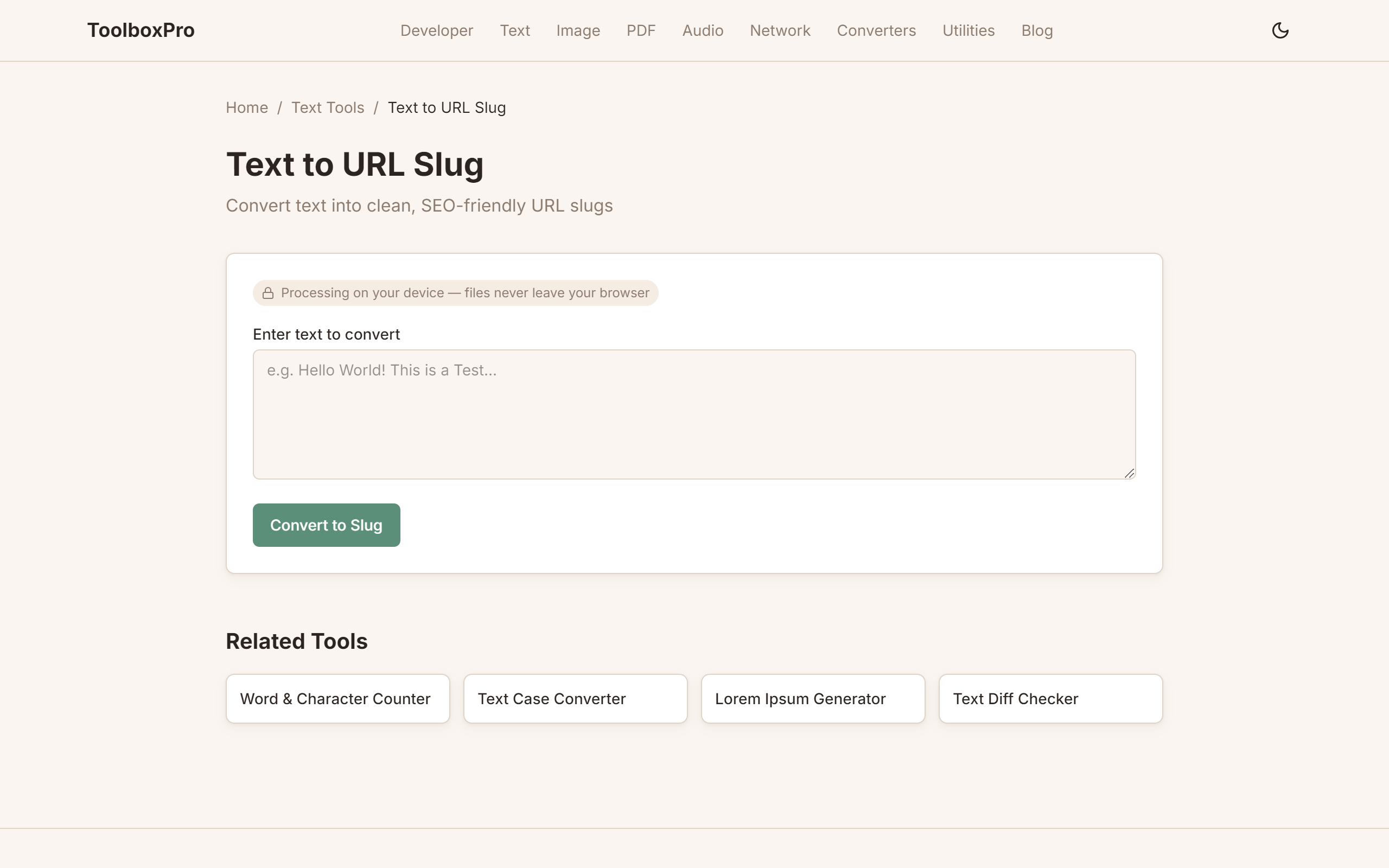
1. Visit our Slug Generator
2. Type or paste your text (e.g., "How to Bake a Cake in 10 Minutes!")
3. See the slug generated in real-time: "how-to-bake-a-cake-in-10-minutes"
4. Click Copy to copy the slug to your clipboard
Examples
| Original Text | Generated Slug |
|---|---|
| My First Blog Post! | my-first-blog-post |
| 10 Ways to Save Money 💰 | 10-ways-to-save-money |
| Cómo Hacer Paella Valenciana | como-hacer-paella-valenciana |
| Tom & Jerry: The Movie (2024) | tom-jerry-the-movie-2024 |
| What's New in React 19? | whats-new-in-react-19 |
| 100% Organic Cotton — Buy Now! | 100-organic-cotton-buy-now |
| Café & Bakery | cafe-bakery |
| _Important — DO NOT DELETE_ | important-do-not-delete |
SEO Best Practices for Slugs
Do ✅
Don't ❌
Slug vs. URL Path: What's the Difference?
The slug is the final segment of the URL path. The full path might include categories or date hierarchies:
\\\`
example.com/blog/2026/05/text-to-slug-guide
│ │ │ │ │
│ │ │ └── Slug │
│ │ └── Date segments │
│ └── Category segment │
└── Domain │
│
This whole thing is the URL path
\\\`
Most modern SEO strategies recommend flat URL structures with minimal path segments, putting the focus on the slug itself.
Programmatic Slug Generation
\\\`javascript
function slugify(text) {
return text
.toLowerCase()
.trim()
.replace(/[^\\w\\s-]/g, '') // Remove non-word chars (except spaces and hyphens)
.replace(/[\\s_]+/g, '-') // Replace spaces and underscores with hyphens
.replace(/-+/g, '-') // Collapse multiple hyphens
.replace(/^-+|-+\$/g, ''); // Trim hyphens from start and end
}
\\\`
FAQ
Should I use hyphens or underscores in URLs? Hyphens. Google treats hyphens as word separators but underscores as word joiners. \my-file-name\ is read as "my file name" but \my_file_name\ is read as "myfilename".
How long should a slug be? 30-60 characters is ideal. Google's search results typically show the first 60 characters of a URL.
Do slugs affect SEO ranking? Yes — the URL slug is a confirmed ranking factor. Including your target keyword in the slug gives a small but measurable SEO boost.
Can I change a slug after publishing? You can, but you should set up a 301 redirect from the old URL to the new one. Otherwise, any links to the old URL will break.
Does casing matter in URLs? While web servers typically treat URLs case-insensitively, lowercase slugs are the universal convention. Mixed-case URLs can cause duplicate content issues.
Advanced Tips
Multilingual and Unicode Slug Handling
Generating slugs from non-ASCII text is more nuanced than it appears. Each language has different transliteration rules, and getting them wrong breaks both SEO and usability.
Libraries like @sindresorhus/slugify (Node) and python-slugify (Python) handle most Unicode edge cases out of the box by normalizing to NFKD form before stripping non-ASCII characters.
SEO Best Practices for URL Structure
URL Structure Optimization
When migrating or restructuring, map old slugs to new ones with 301 redirects at the server level (Nginx return 301, Apache Redirect 301, or Cloudflare Page Rules). Use a canonical tag () on every page to tell search engines which URL is the authoritative version. For pagination, use ?page=2 query strings rather than /page/2/ path segments — query strings don't fragment crawl budget the way path depth does.
Common Mistakes
Real-World Use Cases
Try it yourself with our free online tool:
Try URL Slug Generator: How to Convert Text to Clean SEO Slugs →