Image to Base64 Converter: Inline Images Without External Files
Convert any image to a Base64 data URI for embedding directly in HTML, CSS, or JavaScript. No external image files needed.
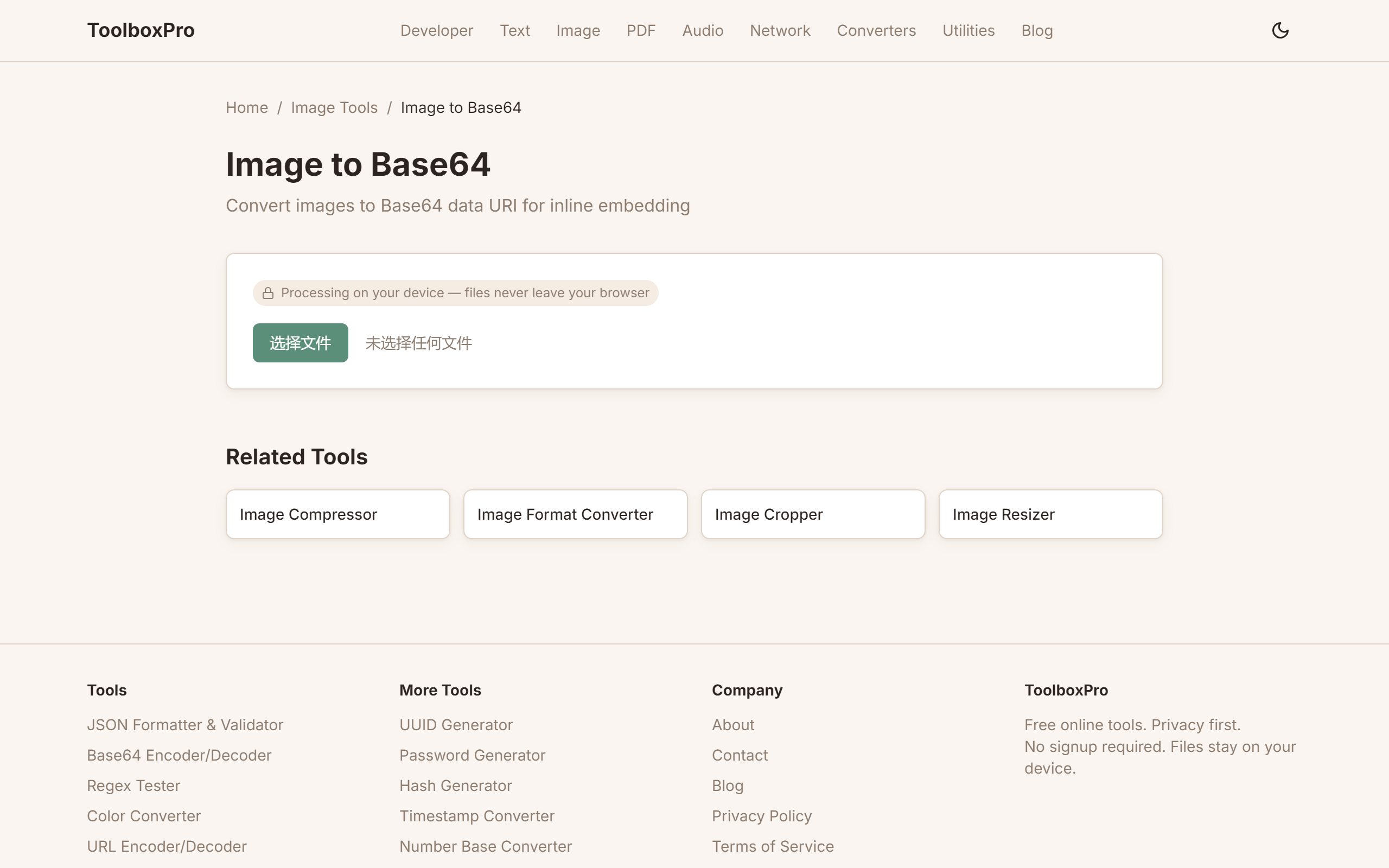
What is Image to Base64?
Base64 encoding converts binary image data into a text string composed of 64 printable characters (A-Z, a-z, 0-9, +, /). When you convert an image to Base64, you get a long string of text that represents the complete image file.
This string can be embedded directly in HTML, CSS, or JavaScript as a data URI:
\\\`html

\\\`
The browser decodes the Base64 string and renders the image — no separate HTTP request needed.
When to Use Inline Base64 Images
✅ Good Use Cases
❌ Avoid For
The Math: Request Overhead vs. Encoding Overhead
The classic argument for Base64 is reducing HTTP requests. Here's the trade-off:
| Image Size | HTTP Overhead (approx.) | Base64 Overhead (33%) | Verdict |
|---|---|---|---|
| 1 KB | ~0.5 KB (headers + TLS) | ~0.3 KB | Base64 wins |
| 5 KB | ~0.5 KB | ~1.7 KB | Comparable |
| 10 KB | ~0.5 KB | ~3.3 KB | HTTP request may win |
| 50 KB | ~0.5 KB | ~16.5 KB | External file wins |
| 100 KB | ~0.5 KB | ~33 KB | External file wins heavily |
Rule of thumb: Under 5KB → Base64. Over 10KB → external file.
How to Convert an Image to Base64
Using ToolboxPro
1. Visit our Image to Base64 Converter
2. Upload an image by clicking or dragging
3. The tool instantly generates the Base64 string
4. Choose your output format:
- Data URI — ready to paste into \src\ attributes: \data:image/png;base64,...\
- Raw Base64 — just the encoded string, no prefix
5. Copy the result with one click
Supported Formats
| Format | MIME Type | Best For |
|---|---|---|
| PNG | image/png | Icons, logos, screenshots |
| JPG | image/jpeg | Photos, complex images |
| GIF | image/gif | Simple animations |
| WebP | image/webp | Modern web-optimized images |
| SVG | image/svg+xml | Vector graphics |
| BMP | image/bmp | Legacy compatibility |
| ICO | image/x-icon | Favicons |
Using Base64 Images in Different Contexts
In HTML
\\\`html

\\\`
In CSS
\\\`css
.background-image {
background-image: url("data:image/svg+xml;base64,PHN2ZyB4bWxucz0...");
}
\\\`
In JavaScript
\\\`javascript
const img = new Image();
img.src = "data:image/png;base64,iVBORw0KGgo...";
document.body.appendChild(img);
\\\`
In Email HTML
Email clients block external images by default. Base64 images always render:
\\\`html

\\\`
Performance Considerations
1. Gzip compresses Base64 well — while Base64 text is 33% larger than binary, gzip reduces that gap significantly (often to 3-5% overhead after compression)
2. CSS background images aren't cached separately — inline Base64 in CSS means the entire stylesheet must be re-downloaded on every visit unless the CSS file itself is cached
3. HTML size impacts Time to First Byte (TTFB) — large inline images increase the initial HTML payload, delaying when the browser can start parsing
4. Mobile considerations — limited memory devices may struggle decoding large Base64 strings
FAQ
Is Base64 compression? No. Base64 is encoding, not compression. The encoded string is always larger than the original binary data by approximately 33%.
Can I convert Base64 back to an image? Yes. Our tool can decode Base64 strings back into downloadable image files. Paste the Base64 string and click Download as image.
Is there a file size limit? Our tool handles images up to ~50MB. However, for practical use, we recommend Base64 only for images under 10KB.
Does Base64 work in all browsers? Yes. Data URIs are supported in every modern browser, including Chrome, Firefox, Safari, and Edge. Support goes back to Internet Explorer 8.
standard Base64 is used.
Advanced Tips for Working with Base64 Images
1. Lazy-decode large strings — Instead of embedding a massive Base64 string directly in your HTML, load it via JavaScript and set the src dynamically after the page's critical content renders. This prevents the Base64 payload from blocking first paint.
2. Use data: URIs inside CSS variables — Store small patterns (gradients, noise textures) as Base64 in a :root custom property, then reference them across components: background: var(--noise-texture);. This centralizes asset management and simplifies theming.
3. Pre-optimise images before encoding — Run images through a compressor (ImageOptim, squoosh.app) *before* converting to Base64. A 40KB PNG compressed to 12KB becomes a 16KB Base64 string — well within the recommended inline threshold.
4. Combine with SVG for responsive placeholders — Encode a low-quality SVG placeholder as Base64, then swap in the full-resolution raster image on load. The LQIP technique (Low Quality Image Placeholder) gives users instant visual feedback while the real asset downloads.
Common Mistakes to Avoid
1. Inlining images above 50KB — The 33% size overhead combined with blocking HTML parsing creates measurable LCP (Largest Contentful Paint) regressions. Tools like Lighthouse will flag this as a performance issue.
2. Forgetting MIME type prefixes — A raw Base64 string without the data:image/png;base64, prefix won't render in src attributes.
3. Storing Base64 in a database without compression — A 2MB profile photo becomes a ~2.7MB Base64 string in your database row. Store the binary file on object storage (S3, Cloudinary) instead, or compress the Base64 column at the database level.
4. Ignoring CSP (Content Security Policy) rules — If your site uses a strict CSP, data: URIs may be blocked unless you explicitly add img-src data: to your policy header. Test in production after deploying Base64 assets.
Real-World Examples
Email Newsletter with Inline Logo
Marketing emails can't reliably load external images — Gmail and Outlook block remote content by default. Embedding your logo as a Base64 PNG ensures it renders on open:
<img src="data:image/png;base64,iVBORw0KGgoAAAANSUhEUgAA..."
     alt="Company Logo" width="200" height="60" />
Keep the logo under 8KB. Larger inline images get stripped by Gmail's HTML sanitizer (it truncates emails over 102KB of HTML).
Single-File HTML Report
When distributing an analytics dashboard as a standalone .html file (no server, no dependencies), embed all charts and icons as Base64. The recipient double-clicks the file and sees a fully rendered report — no broken image links, no CORS errors.
Comparison: Base64 vs. External File vs. SVG
| Approach | Best For | Caching | Size Overhead | Complexity |
|---|---|---|---|---|
| **Base64 Data URI** | <5KB assets, emails, single-file HTML | Poor (re-downloaded each visit) | +33% | Low |
| **External File (CDN)** | >10KB images, multi-page sites | Excellent (browser + CDN) | None | Medium |
| **Inline SVG** | Icons, logos, simple graphics | Inherits parent cache | None (often smaller) | Medium |
| **CSS Sprite** | Many small icons in one file | Good | None | High |
Verdict: Use Base64 sparingly. For modern web development, inline SVG handles most icon needs with zero overhead, and CDN-hosted files win for everything else. Reserve Base64 for emails, single-file deliverables, and sub-5KB assets where the HTTP request cost exceeds the encoding overhead.
Try it yourself with our free online tool:
Try Image to Base64 Converter: Inline Images Without External Files →